
The Emperor’s Garage
Lawrence Stroll and Aston Martin’s Crisis of Control

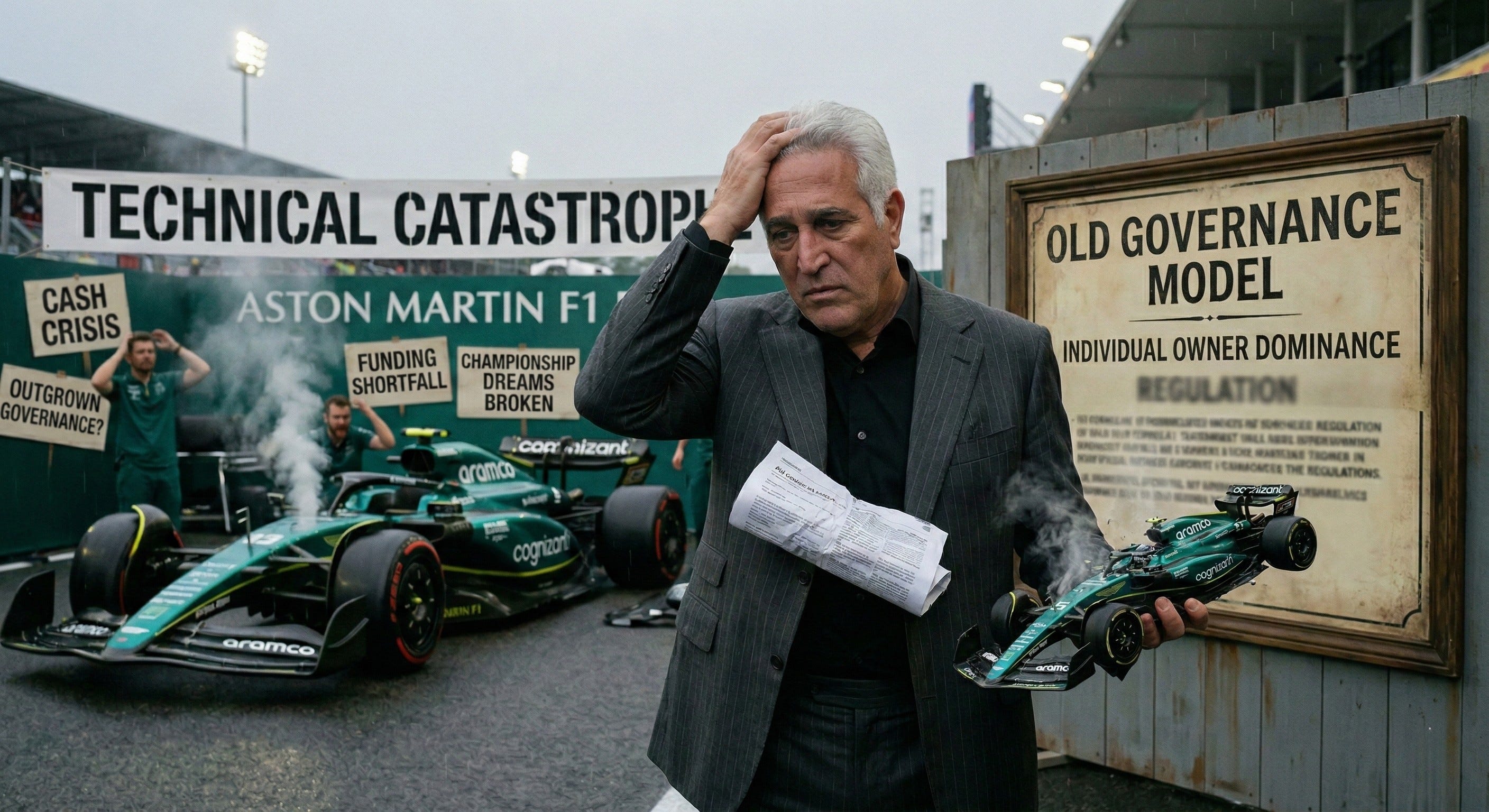
The billionaire who bet everything on building a championship-winning Formula 1 team now presides over a technical catastrophe, a corporate cash crisis, and a governance model that the sport’s own evolution may have outgrown.
When Lawrence Stroll led a consortium to rescue the former Force India team in 2018, the vision was audacious: transform a perennial midfield contender into a world championship operation, underwritten by the Aston Martin brand and bankrolled by one of Canada’s wealthiest men. A new factory. A state-of-the-art wind tunnel. Adrian Newey. A works Honda engine deal. No expense, it seemed, would be spared.
Seven years later, as Formula 1’s sweeping 2026 technical regulations usher in a new competitive era, the project is in crisis on virtually every front. The car is catastrophically slow. The parent company is haemorrhaging cash. Hundreds of employees have been shown the door. And at the apex of every decision, exercising the kind of concentrated authority that sports governance researchers have spent decades studying and critiquing, sits Lawrence Stroll himself.
This is a story about what happens when autocratic leadership meets an unforgiving technical sport, and whether the governance model that built Aston Martin’s ambition is now the very thing constraining its recovery.
The Autocrat’s Playbook
Lawrence Stroll’s management philosophy has never been a secret. He operates with the directness and singular authority of the private equity world from which he emerged, applying to Formula 1 the same top-down decisiveness that built his fortune through fashion brands like Tommy Hilfiger and Michael Kors. Within the paddock, he is known for an exacting, confrontational style. Reports of shouting matches with senior staff have surfaced periodically, painting a picture of a proprietor who demands results and tolerates few excuses.
In governance terms, this is a textbook centralised, presidential model. Research into sports organisations across multiple regions consistently identifies this structure as one where power concentrates in a small number of decision-makers, often a single controlling figure, and where strategic direction flows downward with limited participatory input from technical staff, athletes, or commercial stakeholders. Comparative studies of sporting federations and private enterprises show that such models persist widely despite growing evidence that more collaborative frameworks deliver better long-term outcomes. The centralised model’s chief advantage is speed of execution. Its chief vulnerability is the quality of the decisions being executed.
For Aston Martin, every major strategic call of the past three years bears Lawrence Stroll’s fingerprints. The decision to build a new wind tunnel rather than lease time in an existing facility. The timing of Adrian Newey’s recruitment. The Honda works partnership. The personnel appointments and, increasingly, the personnel removals. The retention of his son, Lance, as a race driver through the new regulatory era. These are not committee decisions. They are the choices of a man who has staked his personal fortune and professional legacy on a single outcome.
The Technical Wreckage
The consequences of those choices are now brutally visible.
Adrian Newey, who officially joined the team in March 2025 and has since taken the unprecedented step of assuming the Team Principal role directly, has conceded that Aston Martin is approximately four months behind its rivals. The root cause is the late commissioning of the new wind tunnel, which only became operational for the 2026 car in April 2025. Every competitor had a significant developmental head start during the most critical phase of the new regulations.
Pre-season testing in Bahrain exposed the deficit in unsparing terms. Aston Martin completed just 122 laps, the fewest of any team on the grid, while frontrunners like Mercedes logged more than 300. The AMR26 is reported to be between 15 and 40 kilograms overweight, running four to four and a half seconds off the pace of the leading cars. The new works Honda power units compounded the misery with chronic unreliability, battery failures, and a critical shortage of spare parts that confined the team to short, conservative stints throughout the test.
The fallout has been swift and severe. Technical Director Dan Fallows was removed following the car’s persistent regression. Andy Cowell, the former Mercedes engine chief recruited as CEO, was shifted sideways to Chief Strategy Officer to accommodate Newey’s sweeping authority. At least seven additional senior staff members have departed. For Lawrence Stroll, who personally courted each of these high-profile hires, the churn represents more than an operational disruption. It raises fundamental questions about whether the governance environment he has created can retain elite talent long enough for it to deliver.
This is one of the central tensions that sports governance research identifies in centralised models. The leader’s authority enables bold moves, such as hiring Newey, but the same authority can destabilise the organisation when those moves require patient, distributed execution across hundreds of engineers and technicians who need psychological safety to innovate. When the boss is known for paddock confrontations and the boss’s son is on the team radio describing the car in unprintable terms, the “no-blame culture” that modern F1 engineering depends upon becomes extremely difficult to sustain.
The Financial Abyss
If the technical picture is grim, the corporate finances are alarming.
Aston Martin Lagonda, the parent company over which Lawrence Stroll presides as Executive Chairman, posted a widened pre-tax loss of £363.9 million (approximately USD $493 million / AUD $692 million) for the 2025 fiscal year. Total revenue dropped 21 per cent to £1.26 billion (USD $1.71 billion / AUD $2.39 billion). Wholesale vehicle volumes fell 10 per cent to 5,448 units, heavily impacted by United States and Chinese import tariffs that have reshaped the luxury automotive market.
The company’s balance sheet tells an even starker story. Net debt has ballooned to £1.38 billion (USD $1.87 billion / AUD $2.62 billion), pushing the adjusted net leverage ratio to 12.8 times, a figure that would trigger alarm bells in any boardroom. The response has been a programme of aggressive cost-cutting: a 20 per cent reduction of the global workforce, axing approximately 600 jobs and targeting savings of £40 million (USD $54 million / AUD $76 million), alongside a £300 million (USD $406 million / AUD $570 million) reduction in the five-year capital expenditure plan.
Perhaps the most symbolically revealing transaction was Aston Martin’s sale of the F1 team’s naming rights to Lawrence Stroll’s own AMR GP Holdings for £50 million (USD $68 million / AUD $95 million). On one level, it is a pragmatic liquidity injection. On another, it is the controlling shareholder effectively buying his own brand back from himself, a circular transaction that illustrates just how intertwined Lawrence Stroll’s personal holdings and the public company’s fortunes have become. For minority shareholders and governance observers alike, it raises questions about conflicts of interest, related-party transactions, and the structural independence of the board.
The Son in the Cockpit
No examination of Lawrence Stroll’s governance is complete without addressing the most visible manifestation of concentrated authority: his son’s position in the team.
Lance Stroll’s contract was extended alongside Fernando Alonso for the 2026 regulatory era. Team Principal Mike Krack praised Lance’s technical feedback and committed simulator work, crediting him with contributing to the car’s ongoing development. The team recently restructured its trackside engineering setup, promoting Gary Gannon to Senior Race Engineer and installing Stephen Glass as Lance’s dedicated Race Engineer. The messaging positions Lance as a developmental pillar.
The paddock’s assessment is more divided. Former F1 driver Ralf Schumacher publicly criticised Lance after the British Grand Prix, where Stroll’s team radio outburst denigrated the car in terms that disrespected the work of the mechanics and engineers. During the 2023 Qatar Grand Prix, Lance was filmed throwing his steering wheel and shoving his physiotherapist after a qualifying elimination. Krack downplayed the incident, but the broader question is structural rather than behavioural: in any other team, would a driver with Lance Stroll’s track record retain his seat through this level of crisis? The answer, for most paddock observers, is straightforward, and that answer tells you everything about how power flows within this organisation.
From a governance perspective, the dynamic exemplifies what researchers describe as the gap between stated aspirations and embedded power structures. The team articulates a collaborative development culture, but the driver lineup is determined by familial authority. The organisation promotes engineering candour, but the owner’s son is publicly criticising the product on a global broadcast. These contradictions do not resolve themselves. They accumulate, and they shape the internal culture in ways that no restructuring of the engineering department can easily fix.
Governance Against the Grain
What makes Lawrence Stroll’s model so analytically striking is how sharply it cuts against the direction that sports governance is evolving.
Contemporary research highlights a decisive shift from hierarchical, control-oriented models toward participatory frameworks that position athletes, technical staff, and commercial stakeholders as co-creators of value. Digital platforms have empowered athletes to build autonomous brands, bypass traditional intermediaries, and engage directly with fans, creating a decentralised ecosystem that demands more adaptive governance from the organisations around them. Emerging technologies like blockchain are being explored for their potential to further decentralise event management and enhance transparency. Studies into environmental, social, and governance integration demonstrate that robust ESG performance enhances corporate value through brand equity optimisation, particularly when supported by favourable policy environments.
Aston Martin’s trajectory runs against nearly every one of these currents. Authority is concentrated rather than distributed. Transparency is limited by the intermingling of private and public interests. ESG commitments are difficult to sustain when the parent company is slashing its workforce by 20 per cent and cutting capital expenditure to stay solvent. The team’s digital and commercial strategies are shaped by a proprietor’s vision rather than emerging from distributed stakeholder input.
None of this means the centralised model cannot produce results. Red Bull Racing, under the late Dietrich Mateschitz’s ownership, demonstrated that a strong proprietorial vision combined with elite technical leadership could dominate the sport. But the critical difference is execution quality. Mateschitz invested in operational autonomy for his technical team. Stroll’s model, by the evidence available, retains tighter personal control over a wider range of decisions, from driver selection to corporate transactions, and that breadth of control becomes a liability when the decisions start compounding against you.
Risk and Resilience
The sports governance literature consistently identifies risk management as a critical but underdeveloped function within sporting organisations. Effective frameworks must address financial instability, legal liabilities, operational disruptions, political risks related to public funding dependencies, and ethical dilemmas posed by new technologies. Scoping reviews have found that few organisations systematically integrate risk assessment with strategic planning.
Aston Martin’s current predicament reads like a case study in cascading risk. The wind tunnel delay created a technical risk that manifested as a catastrophically uncompetitive car. The Honda partnership introduced supply chain and reliability risks that materialised during the most important test of the year. The parent company’s financial fragility created a corporate risk that is now constraining the F1 team’s ability to invest its way out of trouble. The concentrated governance model created a decision-making risk in which the quality of outcomes depends disproportionately on the judgement of a single individual.
Each of these risks was identifiable in advance. Whether they were identified and accepted, identified and mitigated inadequately, or simply overlooked is a question only those inside the organisation can answer. But the cumulative result is an operation that has entered the 2026 season with almost no margin for error, led by a man whose governing philosophy is predicated on the belief that he can will outcomes through force of investment and personal authority.
The Reckoning Ahead
As Aston Martin approaches the season-opening Australian Grand Prix in Melbourne, the question hovering over the team is not simply whether the AMR26 can be made competitive. It is whether the governance structure that Lawrence Stroll has built around himself is capable of the adaptive, distributed, psychologically safe decision-making that modern Formula 1 demands.
Adrian Newey’s arrival was supposed to be the transformative moment. The greatest aerodynamicist in the sport’s history, given absolute technical authority and the resources to reshape the organisation. But even Newey operates within a structure where the Executive Chairman is the majority shareholder, the majority shareholder’s son occupies a race seat, and the parent company’s financial distress limits the room for manoeuvre. Genius does not operate in a vacuum. It operates in a culture, and culture flows from governance.
The car can be fixed. Wind tunnels generate data on their own schedule, and four months of deficit can, in theory, be closed over the course of a season. Honda’s power units can be made reliable. Weight can be stripped from the chassis. But governance is not a technical problem with a technical solution. It is a human problem, embedded in structures of authority, accountability, and trust that take years to build and moments to erode.
Lawrence Stroll bet everything on the belief that Formula 1 could be conquered the way a luxury fashion brand could be acquired: through capital, conviction, and centralised control. The 2026 season will test whether that belief survives contact with the most technically complex and competitively brutal sport on earth. The machines are unforgiving. The stopwatch does not care who signs the cheques. And for the 600 people who have already lost their jobs, the question of whether the man at the top got it right is not theoretical. It is deeply, painfully personal.